
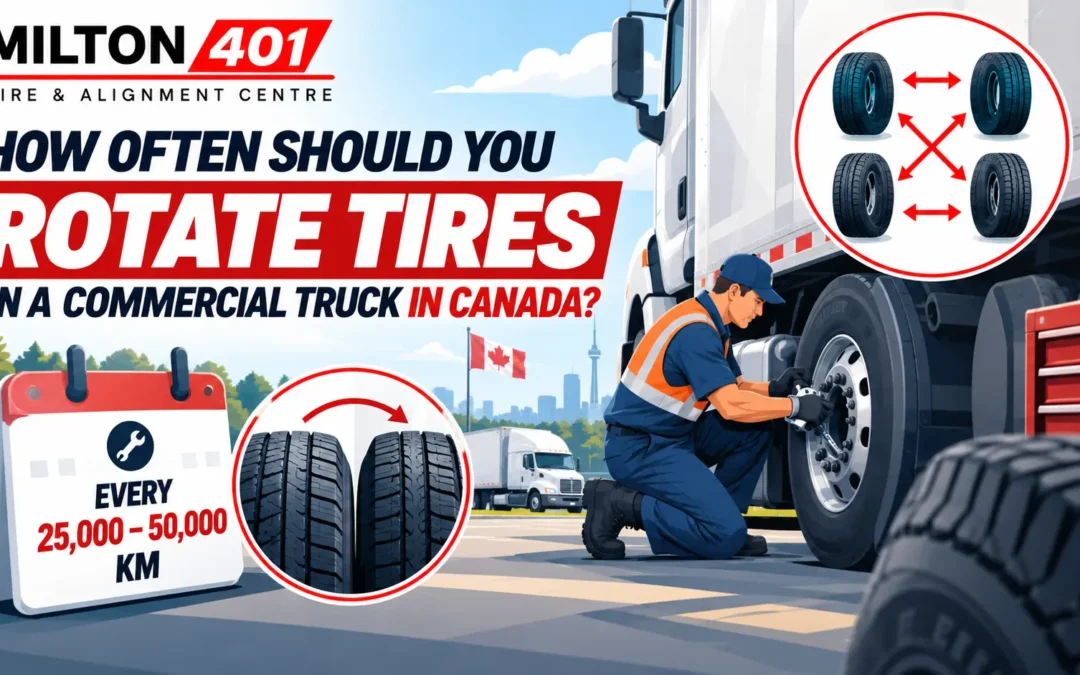
Your commercial truck is hauling loads across the 401 every week and tire rotation for commercial trucks is probably the last thing on your checklist between runs. But skipping it is quietly costing you thousands of dollars per year in premature tire replacement and on Ontario roads, the consequences go beyond the budget.
Quick Answer
In Canada, tire rotation for commercial trucks is recommended at the midpoint of tread life, generally every 80,000 to 100,000 kilometres for long-haul units. Regional and city delivery trucks running shorter routes in Milton and the Halton Region should rotate every 40,000 to 60,000 kilometres, as stop-and-go driving accelerates steer tire wear significantly.
Commercial truck tire rotation is the process of moving tires between axle positions on a vehicle to even out wear across all tires in the set. Because steer, drive and trailer axles place completely different demands on a tire, each position wears rubber at a different rate and in a different pattern. Without planned rotation, steer tires wear faster on the shoulders, drive tires develop heel-and-toe wear from torque and traction loads and trailer tires wear unevenly due to scrub in corners.
According to fleet maintenance research published by Heavy Vehicle Inspection, missing systematic rotation alone reduces commercial tire lifespan by approximately 25%. For a fleet of 50 trucks replacing tires at $400 each, that is tens of thousands of dollars in preventable cost every year, before you account for the alignment, suspension and fuel penalty that uneven wear creates.
So if you are running trucks out of the Harrop Drive industrial zone in Milton, managing a logistics fleet between the GTA and Hamilton or operating a yard truck at a Mississauga distribution centre, this guide gives you the intervals, the rotation patterns and the signs that tell you when it is already overdue.
Why Tire Rotation for Commercial Trucks Is Different From Passenger Vehicles
On a passenger car, tire rotation is straightforward. Most follow a simple X pattern or front-to-back swap every 8,000 to 12,000 kilometres.
On a commercial truck, the situation is more involved. Three distinct tire types operate across multiple axles, each engineered for a specific load and function:
- Steer tires sit on the front axle. They handle steering input, braking load and the weight of the engine. They are built with ribbed tread for precise tracking but wear faster than drive or trailer tires because they do the work of both guiding and stopping the truck.
- Drive tires sit on the powered rear axle or tandem axles. They provide traction under acceleration and uphill grades, wear with a heel-and-toe pattern over time and are built with aggressive lug tread for grip.
- Trailer tires are free-rolling. They carry the cargo weight, scrub in corners and are prone to irregular wear when trailer axle alignment is off.
Each of these tire types wears differently, which is why commercial truck tire rotation requires a position-specific approach, not a simple swap.
How Often Should You Rotate Tires on a Truck? Intervals by Vehicle Type
There is no single answer that covers every commercial truck. Rotation frequency depends on the truck’s application, the routes it runs, the loads it carries and the axle configuration. Here is a practical breakdown.
| Vehicle Type | Typical Application | Recommended Rotation Interval |
|---|---|---|
| Class 8 long-haul tractor-trailer | Highway routes, 401/407 corridor | Every 80,000 to 100,000 km |
| Regional delivery truck (Class 6 to 7) | GTA to Halton Region routes | Every 50,000 to 70,000 km |
| City delivery van or light commercial (Class 3 to 5) | Urban stop-and-go, Milton to Brampton | Every 30,000 to 50,000 km |
| Construction or work vehicle | Off-road or mixed surface | Every 25,000 to 40,000 km |
| Yard truck | Short-distance, high-turn dock work | Every 20,000 to 30,000 km or by tread depth |
| 4WD pickup truck used commercially | Mixed highway and work site | Every 10,000 to 15,000 km |
Intervals are general guidelines. Always follow manufacturer recommendations for your specific tire and vehicle. Source: Rush Truck Centers, Heavy Vehicle Inspection, STTC Commercial Tire.
The trucks with the shortest intervals are yard trucks and construction vehicles. These units spend their time turning at low speed, driving over rough surfaces and stopping hard on loose material. That combination tears through tread in specific spots while leaving other areas barely touched. Rotation is the only way to redistribute that wear before it becomes irreversible.
Commercial Truck Tire Rotation Patterns: What Goes Where
This is where many fleet operators get it wrong. Rotating commercial truck tires is not as simple as swapping front and rear. The pattern depends on your axle configuration, whether your tires are steer-specific or all-position rated and whether you are running singles or duals.
Steer Axle Tires
Steer tires should always be rotated side-to-side, meaning the left front moves to the right front position and vice versa. They should not be moved to drive or trailer positions mid-life unless they meet the tread requirements for those positions. Steer tires are built for steering precision and have tread patterns that function best on the front axle.
Drive Axle Tires (Tandem or Single)
Drive tires can be rotated in an X pattern, meaning they cross both side and axle position. A tire on the left outer of the forward drive axle moves to the right inner of the rear drive axle and the pattern repeats across the set. The goal is to ensure each tire eventually experiences outer edge loading, inner loading and variations in torque demand.
Trailer Axle Tires
Trailer tires rotate side-to-side between trailer axles when running tandems or can be moved to the drive axle position at half tread life if they meet drive axle load ratings. Irregular trailer tire wear often points to a trailer axle alignment issue rather than a rotation schedule problem.
4WD Pickup Trucks Used Commercially
For 4WD trucks running both on-road and work site routes, the standard rotation pattern is a forward cross where rear tires move straight forward and front tires cross to the opposite rear position. Some manufacturers specify a rearward cross or X pattern. Always confirm with your vehicle’s owner manual, as some 4WD systems are sensitive to tread depth differences between axles.
What Happens When You Skip Tire Rotation on a Commercial Truck
We see the results of skipped rotations at our shop on Harrop Drive regularly. A fleet manager brought in a three-axle regional delivery truck last spring that had been running Mississauga to Hamilton routes for 14 months without a rotation. The steer tires had worn down to 3/32 on the inside shoulder while the drive tires still had 8/32 remaining. The truck was already pulling left under braking because the uneven steer wear had shifted the effective contact patch.
The cost: two steer tires replaced early, a four-wheel alignment and an inspection of the front suspension for stress damage from the prolonged uneven load. All of that was avoidable with two rotation services over the same period.
Here Is What Uneven Wear Causes Over Time:
- Premature tire replacement — tires wear out faster in specific spots and have to be replaced long before the rest of the set reaches end of life
- Alignment drift — uneven tire wear changes the effective diameter between positions, which pulls the steering off-centre and throws out alignment settings
- Increased fuel consumption — the Tire and Rubber Association of Canada (TRAC) notes that underinflated and unevenly worn tires increase rolling resistance and reduce fuel economy; for a long-haul fleet, even a 1% fuel penalty adds up to thousands of dollars annually
- Suspension wear — irregular tire wear places asymmetric loads on wheel bearings, tie rods and control arms, accelerating wear in components that cost far more to replace than tires
- Safety exposure — steer tires with worn-out inside shoulders reduce braking performance and wet weather grip, increasing stopping distances at highway speed
How to Tell Your Truck Tires Need Rotation Now
You do not always need to wait for a scheduled interval. These are the signs that tell you rotation is overdue regardless of the kilometre reading.
- Uneven tread depth across the axle — if one side of a steer tire has 4/32 and the other has 7/32, side-to-side rotation is needed immediately
- Inside or outside edge wear on steer tires — this indicates the steer tires have been sitting too long in one position combined with an alignment issue
- Heel-and-toe pattern on drive tires — the leading edge of each tread block is wearing faster than the trailing edge, a common sign of overdue rotation and potentially insufficient inflation
- Trailer tires wearing on one side only — almost always a trailer axle alignment issue, but rotation should accompany the alignment correction
- Vibration at highway speed — can be caused by irregular wear that has developed into a pattern on the tire; rotation and balancing together are needed
So if any of these look familiar from your last walk-around inspection, book the service before the next run, not after.
Tire Rotation and Wheel Alignment: Why You Need Both
Rotating commercial truck tires without checking alignment first is half the job. And checking alignment without rotating the tires is the other half left undone.
Here is why they work together. Uneven tire wear changes the effective rolling diameter of the tire. A drive tire with more tread on the right than the left creates a slight pull in the steering because the two sides are not rolling at exactly the same rate. When you rotate that tire to a new position, it carries the wear pattern with it. If the alignment is also off, the new position continues to develop the same irregular wear in the same spots.
The correct sequence is: inspect wear patterns first, identify any alignment-related causes, correct the alignment, then rotate the tires so each position starts fresh with even wear going forward.
For commercial trucks running Ontario highways, steer axle alignment is particularly sensitive. A misaligned steer axle increases tire scrub on every kilometre, which adds up fast on a truck covering 150,000 kilometres per year. According to Heavy Vehicle Inspection data, improper alignment can reduce tire life by the equivalent of 20,000 kilometres or more per set.
At Milton 401 Tire, our truck alignment equipment handles both front steer axle alignment and drive axle tracking checks. We also flag trailer axle alignment issues, which are a frequent cause of irregular trailer tire wear that most operators attribute incorrectly to the tires themselves.
Building a Rotation Schedule for Your Fleet
If you manage more than one commercial vehicle, tracking rotation by memory or paper is a setup for missed intervals. Here is a simple framework that works for small to mid-size fleets operating out of the Milton and GTA area.
Step 1: Set a Rotation Trigger by Kilometres, Not Calendar.
Commercial trucks in different applications accumulate kilometres at different rates. A calendar reminder for every three months misses trucks that run light and catches others after it is already too late.
Step 2: Log Tread Depth at Every Service.
Record the tread depth at four points across each tire at every rotation and inspection. This gives you trend data and catches irregular wear before it shortens tire life significantly.
Step 3: Rotate and Align Together on a Fixed Schedule.
For most commercial fleets, combining the tire rotation service with an alignment check at the same interval prevents the two services from drifting apart in timing.
Step 4: Inspect Trailer Axle Alignment Separately.
Trailer axles are often overlooked. If your trailer tires are wearing faster on one side, the trailer needs its own alignment check, not just a tire rotation.
FAQ: Commercial Truck Tire Rotation in Ontario
Q: How often should you rotate tires on a commercial truck in Canada?
For long-haul Class 8 trucks running Ontario highways like the 401 and 407, most tire specialists recommend rotating at approximately 80,000 to 100,000 kilometres or at the midpoint of tread life. Regional and city delivery trucks should rotate more frequently, every 40,000 to 60,000 kilometres, because stop-and-go driving wears steer tires faster.
Q: What is the correct rotation pattern for a commercial truck?
Steer tires rotate side-to-side within the steer axle. Drive tires rotate in an X pattern, crossing both side and axle position across tandem drive axles. Trailer tires rotate side-to-side between trailer axles. The correct pattern depends on your axle configuration, tire type ratings and whether you are running single or dual tires on drive positions.
Q: Do I need a wheel alignment when I rotate commercial truck tires?
You should inspect alignment at every rotation service and correct it before rotating if uneven wear patterns indicate it is off. Rotating tires onto a misaligned axle carries the wear problem to the new position. For steer axles in particular, alignment and tire rotation should be treated as one combined service.
Q: Can you rotate commercial truck tires and passenger car tires the same way?
No. Passenger vehicle tire rotation follows a simple X or front-to-back pattern. Commercial trucks use position-specific rotation based on steer, drive and trailer axle designations. Steer tires are not moved to drive or trailer positions mid-life without confirming they meet the rating requirements for those positions.
Q: How do I know if my commercial truck tires need rotating now?
Check tread depth at the inside and outside shoulder of each steer tire. A difference of more than 2/32 between sides indicates rotation is overdue. Also watch for heel-and-toe wear on drive tires, single-shoulder wear on trailer tires and any vibration at highway speed that is not resolved by balancing alone.
Book Your Commercial Truck Tire Rotation at Milton 401 Tire
If your trucks are due for a rotation or you want a written tread depth report before deciding on a schedule, we can help. At Milton 401 Tire on Harrop Drive, we service commercial trucks, pickup trucks, trailers and fleet vehicles across the Halton Region, Oakville, Burlington, Mississauga and Brampton corridors.
We combine tire rotation with wheel alignment checks and provide fleet operators with a written condition report after every service. Call us at +1 416-688-9624 or book your service online at milton401tires.com. We are conveniently located off Highway 401 in Milton and equipped to handle trucks from single-unit pickups to multi-axle commercial rigs.