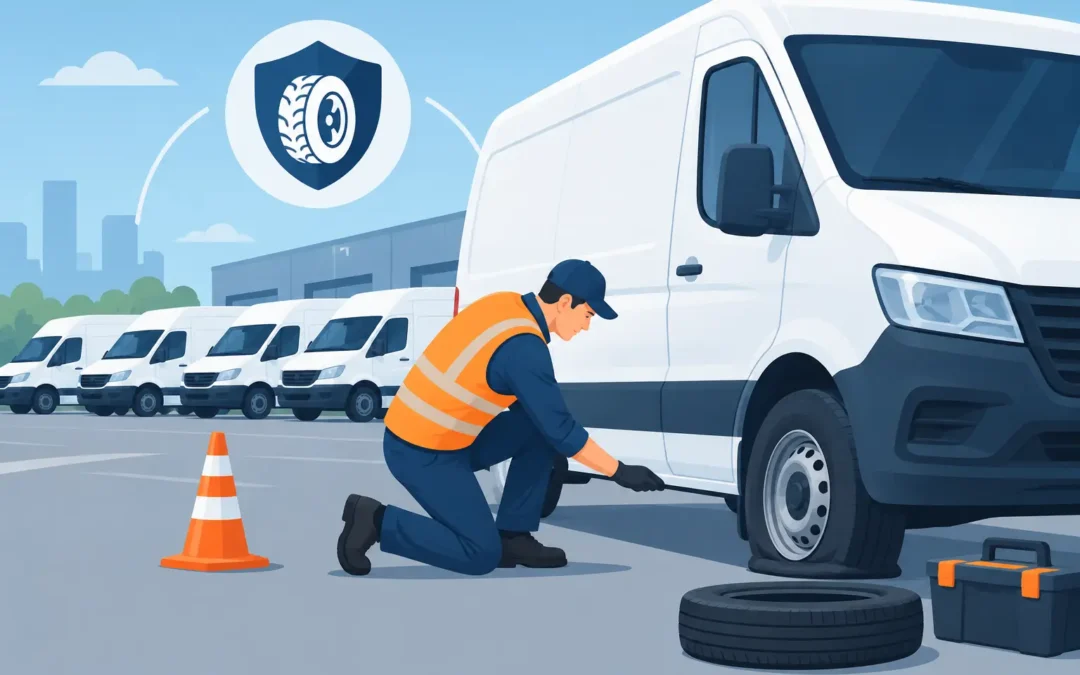
A tire failure on a delivery route rarely stays a tire problem. One disabled van, straight truck, trailer, or service vehicle can delay customers, disrupt dispatch, put cargo at risk, and leave a driver exposed on a busy shoulder. Delivery fleet tire failure is costly because it takes an asset out of service at the exact moment it is needed most.
The good news is that most failures give warning signs well before a blowout or roadside flat. A consistent inspection routine, correct inflation, proper loading, and fast professional response can keep small tire issues from becoming missed deliveries and expensive emergency calls.
What Causes Delivery Fleet Tire Failure?
Tires fail for many reasons, but the root cause is often operational rather than random. Delivery vehicles make frequent stops, run curbside routes, carry changing loads, and spend long hours in traffic. That combination creates conditions passenger vehicles do not always face.
Underinflation is one of the most common causes. A tire that is low on air flexes excessively as it rolls, producing heat that damages the internal structure. It may look usable during a quick walk-around, but heat buildup can weaken the casing and lead to a sudden failure at highway speed. Slow leaks from punctures, valve issues, damaged beads, or neglected pressure checks are especially common in hard-working fleets.
Overloading creates a different problem. Every tire has a load rating, and that rating assumes the tire is inflated correctly. When a vehicle or trailer regularly carries more weight than the tires, axle, or setup can handle, the tread and sidewalls are under constant strain. Even a short route can become risky when the vehicle is loaded unevenly or cargo shifts during transit.
Road hazards also matter. Potholes, construction debris, curbs, sharp metal, and broken pavement can cut a tire or damage a wheel. A driver may not notice the impact at the time, yet the tire can develop a sidewall bulge, internal separation, or slow leak that appears later in the shift.
Alignment and suspension problems are another frequent contributor. If a vehicle pulls to one side, the steering wheel is off-center, or a tire wears faster on one edge, the issue may not be the tire alone. Misalignment can destroy tread long before its expected service life. Worn suspension components can make the pattern worse by allowing the tire to bounce, cup, or scrub against the road.
The Costs Go Beyond the Replacement Tire
A replacement tire is usually the smallest line item after a failure. The larger cost comes from downtime. Dispatch may need to reroute stops, send another vehicle, contact customers, and manage late-delivery complaints. A roadside incident can also cost a driver valuable hours and turn a routine route into an overtime shift.
For fleets carrying temperature-sensitive, fragile, or time-critical cargo, the consequences can rise quickly. A tire failure can put freight integrity at risk, especially if the vehicle cannot safely continue or reach a service location promptly. It can also create liability concerns if worn tires, improper loading, or ignored inspection findings contributed to the incident.
There is a trade-off to manage. Running tires longer may seem economical when tread remains, but a tire with irregular wear, casing damage, recurring air loss, or age-related cracking is not a bargain. Fleet managers need to evaluate total cost per mile, not just the purchase price of a tire.
Warning Signs Drivers Should Report Immediately
Drivers are the fleet’s first line of defense. They do not need to diagnose every problem, but they should know when a tire needs attention before the route continues. A practical pre-trip and post-trip check should include these four items:
- Low pressure, a visibly soft tire, or a tire that needs frequent air
- Cuts, exposed cords, bulges, cracks, or objects embedded in the tread
- Uneven wear, including wear on one shoulder, feathering, cupping, or bald patches
- Vibration, pulling, thumping, or a steering change while driving
A driver should also report any significant pothole strike, curb impact, or debris hit, even if the tire appears normal afterward. Sidewall damage and wheel damage are not always visible from a distance.
For dual-tire assemblies, inspections need to be more deliberate. One low tire can force the paired tire to carry extra load, creating excessive heat and increasing the chance that both tires are damaged. A simple pressure check can prevent a much larger roadside problem.
What to Do When a Tire Fails on Route
The first priority is safety, not saving the delivery schedule. If a tire blows out or loses pressure, the driver should hold the steering wheel firmly, avoid sudden braking or sharp steering, and reduce speed gradually. Once it is safe, move out of traffic and choose the most secure available location.
Drivers should not continue driving on a flat tire to finish a route. Doing so can destroy the tire casing, damage the wheel, harm suspension components, and turn a repairable situation into a full replacement. It can also make the vehicle harder to control.
After stopping safely, the driver should notify dispatch with the exact location, vehicle details, tire position, and any known cause, such as a puncture or impact. Clear information helps the fleet send the right support, whether that means a spare, a mobile tire technician, towing, or a replacement vehicle for the cargo.
Roadside service is particularly valuable for commercial fleets because it reduces the delay between the initial call and a safe return to service. Milton 401 Tire & Alignment Centre provides mobile and roadside tire support for delivery vehicles, trucks, trailers, and fleet equipment across Milton and the Greater Toronto Area, including major highway routes where downtime needs to be handled quickly.
Preventing Delivery Fleet Tire Failure Before It Starts
Prevention works best when it becomes part of the fleet’s normal operating routine, not a task completed only after a breakdown. Pressure checks should happen when tires are cold and should follow the vehicle manufacturer, tire manufacturer, and actual load requirements. The pressure listed on a tire sidewall is not automatically the correct operating pressure for every vehicle.
Tread depth should be measured consistently across the tire, not judged by appearance alone. Uneven tread is useful diagnostic information. Inner-edge wear can point to alignment issues, while cupping may indicate suspension or balance concerns. Replacing the tire without correcting the underlying cause often guarantees another early replacement.
Rotation schedules depend on the vehicle, tire setup, and duty cycle. Delivery vans that make frequent turns and stops may wear front tires differently from highway-driven vehicles. Trailer tires may wear differently again, particularly when axle alignment or loading is off. A fleet service plan should account for those differences rather than applying one schedule to every asset.
Loading procedures deserve equal attention. Drivers and loaders should understand vehicle payload limits and distribute weight as evenly as possible. Heavy cargo concentrated on one side or too far behind an axle can overload specific tires and affect handling. This is especially relevant for trailers and box trucks with changing daily loads.
Finally, track tire history. Recording pressure issues, repairs, tread readings, rotations, alignments, and replacements helps identify patterns. If the same position repeatedly loses air or wears early, there is usually a reason worth investigating. Data does not need to be complicated to be useful. A consistent record can reveal whether the problem is driver behavior, road exposure, vehicle condition, loading, or the tire specification itself.
Repair, Replace, or Inspect Further?
Not every puncture requires a new tire. A repair may be appropriate when the damage is limited to the repairable tread area and the tire has not been driven while flat. However, sidewall punctures, bulges, exposed cords, significant impact damage, and tires run at very low pressure may require replacement because the internal structure can no longer be trusted.
The decision should be made after a proper inspection, not based on an external plug alone. Commercial vehicles place real demands on their tires, and a quick temporary fix may not be suitable for a loaded route or highway operation. Certified technicians can inspect the tire from the inside, assess the wheel and valve components, and check for conditions that contributed to the failure.
A dependable fleet is built one inspection at a time. Give drivers permission to report tire concerns early, address wear patterns before they become failures, and keep a responsive service partner ready when the road still throws you a problem.