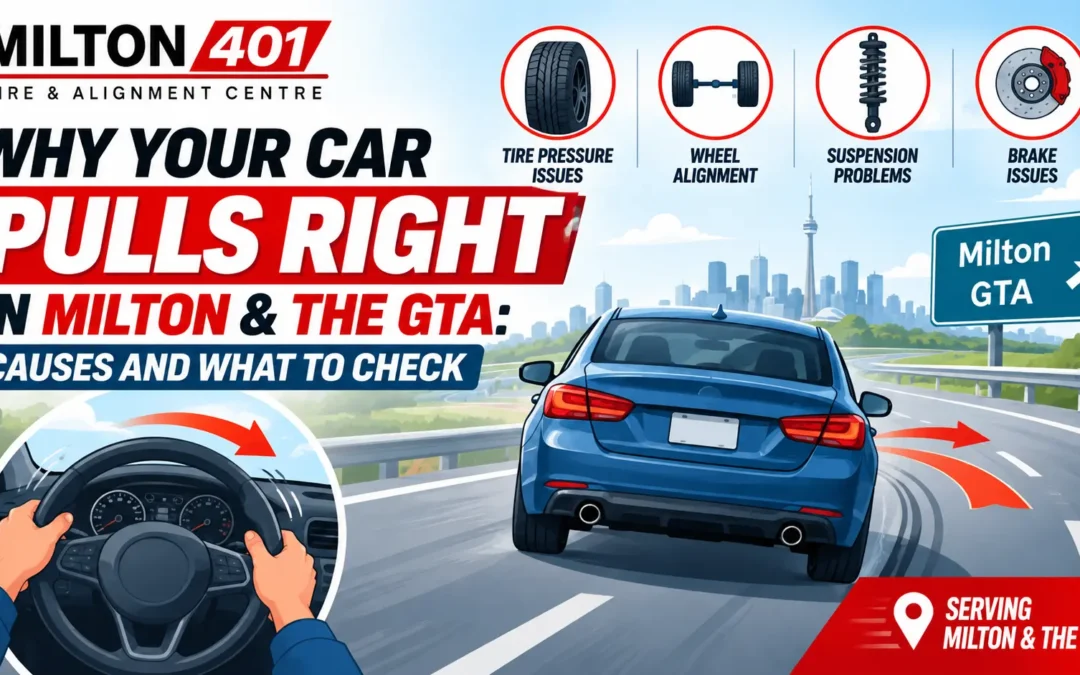
A vehicle that drifts toward the right can turn an ordinary commute into a constant correction. The search for why a car pulls right usually starts after a driver notices the steering wheel needs pressure to stay straight, the vehicle moves right after hitting a pothole or a recent tire change doesn’t feel quite right. Milton and GTA roads add their own wear factors – winter road salt, freeze-thaw potholes, and stop-and-go traffic on the 401 corridor all accelerate the parts that hold a car’s alignment in place.
A pull to one side affects control, tire life, and stopping confidence. For commercial vehicles and fleet operators, it also adds unnecessary wear and downtime. The cause may be as simple as uneven tire pressure, but it can also point to an alignment, brake, suspension or steering problem that needs professional inspection.
Quick answer: A slight rightward drift on many roads is often normal road crown – the built-in slope that drains rainwater to the shoulder. A genuine pull, one that fights your hands on flat pavement, is mechanical: uneven tire pressure, tire conicity, a dragging brake caliper, alignment out of spec or worn suspension and steering parts. Two hands-on-the-wheel tests below tell the difference before you book anything.
Two Checks Before You Book Anything
Do both of these with your hands on the wheel – never test a pull by letting go of it.
- Find flat, empty ground. An empty, level parking lot removes the road’s slope from the equation. Hold the wheel lightly and see whether the car wanders or settles.
- Feel the effort. A road-crown drift is lazy and correctable with a fingertip. A genuine pull is insistent — you’ll notice you’re bracing against it, not just nudging it.
Skip the “change lanes and see if it reverses” test some sources suggest. Highway lanes are often crowned at the center median instead of at the shoulder, so both lanes can slope the same direction and the test tells you nothing useful.
If the car settles on flat ground, the pavement was likely the cause – though a fault that only shows up at highway speed, under braking or with a loaded vehicle won’t necessarily appear in a parking lot test.
Start With the Tires
Tire pressure is the first thing to check because it’s fast, inexpensive, and often overlooked — before moving on to whether the tires themselves are the issue.
- Uneven tire pressure — A low tire on the right side creates more rolling resistance and can pull the vehicle in that direction. Even a few PSI of difference changes how the vehicle tracks, particularly on lighter passenger vehicles. Check pressure when tires are cold, using the number on the driver-side door placard rather than the maximum figure molded into the tire sidewall – that placard reflects the manufacturer’s recommended pressure for the vehicle’s actual weight and tire size. Don’t skip the rear tires; a rear pressure issue can still affect stability.
- Tire conicity — A tire can look fine and still cause a pull. Build variation can leave a tire slightly cone-shaped as it rolls, creating a steady sideways push that no alignment can fully cancel. It often shows up right after new tires go on or after a rotation, once the tire reaches the steering axle.
- Uneven or damaged tread — Look for tread worn more heavily on one shoulder, raised or cupped sections, sidewall bulges, cuts or a tire with noticeably less tread than the others. A qualified technician can swap the front tires side to side as part of diagnosis – if the pull reverses, the tire (or a bent wheel under it) is the likely source.
- If a tire repeatedly loses air, there may be a puncture, damaged valve stem or wheel-sealing issue. Adding air every week is not a repair – have it inspected before a slow leak becomes a roadside flat.
A Brake That Never Fully Releases
If the pull gets stronger the moment you brake, move brake drag higher on the list. A sticking right-front caliper, a seized slide pin, a restricted brake hose or uneven pad movement can make that wheel grab more aggressively than the other side.
Timing is the usual clue: an alignment pull tends to be constant while cruising, while a brake pull shows up or sharpens the moment you touch the pedal – though a car can have both problems at once, so treat this as a strong hint rather than proof.
Other signs of a dragging brake: a burning smell after driving, a wheel noticeably hotter or dustier than its twin, reduced fuel economy or a sluggish feel. Don’t touch a wheel or brake component right after driving – it may be hot enough to cause injury. A dragging brake can overheat pads, rotors, and wheel bearings, and it reduces stopping control when it matters most, so treat it as a same-week fix, not a wait-and-see issue.
Ontario winters make this more common here than in drier climates. Road salt accelerates corrosion on the caliper slide pins that let a brake pad release fully. When those pins seize from rust, the pad never fully backs off, and the car pulls toward that wheel. This is a common enough pattern on Milton and GTA vehicles that it’s worth ruling out before spending on an alignment.
Can Wheel Alignment Cause a Car to Pull Right?
Yes, and it’s one of the most frequent answers, especially if the pull appeared after hitting a pothole, curb or deep construction-zone bump. Alignment is the adjustment of the angles at which your tires meet the road, not just a matter of making the steering wheel look centered.
- Camber — how far the top of the wheel tilts in or out. A car tends to pull toward the side with more positive camber.
- Caster — the tilt of the steering axis, seen from the side. A car pulls toward whichever side has less positive caster.
- Toe — whether the tires point slightly toward or away from each other, seen from above. Toe error is the classic cause of feathered tread wear, and unequal front toe is the usual reason the steering wheel sits crooked while the car still tracks straight.
None of this can be judged by eye. At Milton 401 Tire & Alignment Centre, we use Hunter alignment technology to measure each angle against the vehicle’s factory specifications rather than adjusting by feel.
Milton and GTA roads are hard on alignment angles specifically because of freeze-thaw cycles. Winter frost heave and spring pothole season on routes like the 401, 407, and local Milton streets can knock a wheel out of spec in a single hard hit. A car that tracked straight in the fall can develop a pull by late winter without any single dramatic impact.
What Holds an Alignment: Suspension and Steering Wear
An alignment sets the angles; worn suspension and steering parts let them wander back out. Aligning a car around bad hardware is a repair with an expiration date.
- Control-arm bushings — rubber sleeves that cushion the control arms against the frame. Road salt, heat cycles, and age crack or collapse them, letting the arm shift as you drive.
- Ball joints — the pivots connecting the control arm to the steering knuckle. Worn ones can cause play, vague steering or a clunk over bumps – but a quiet joint isn’t necessarily a healthy one, so this gets inspected rather than just listened for.
- Tie rods carry steering input to the wheels. Worn tie-rod ends wander and won’t hold a line; a badly failed end can separate outright.
This wear is common on vehicles that regularly travel rough roads, carry heavy loads, tow trailers or spend long hours on the highway – which describes a large share of commercial vans, pickups, and trailers running the Milton and GTA corridor.
Newer Causes Worth Ruling Out
A few less-obvious causes are becoming more common as vehicles change:
- ADAS lane-keep-assist drift — If your vehicle’s lane-keeping or lane-departure system is engaged and even slightly miscalibrated, it can actively steer the car toward one side without you realizing the system is intervening. Some vehicles also use “memory steer” through an electric power steering gearbox, which can develop its own bias. Try briefly disabling lane-keep assist (check your owner’s manual) to see if the pull disappears.
- Low or failing power steering fluid/pump — Uneven power steering assist from a low fluid level or a failing pump can make the wheel feel like it’s pulling, especially at low speeds or during parking maneuvers. Whining noises when turning are a common accompanying symptom.
- A seized or frozen wheel bearing — With the vehicle safely raised, a technician can rotate each wheel by hand to check for roughness, noise or resistance that points to a failing bearing rather than an alignment or tire issue.
- Aftermarket lift, level or lowering kits installed without a follow-up alignment are a common source of a new pull that shows up only after suspension work.
When the Pull Happens Matters
| If the pull happens… | Start by checking… |
|---|---|
| All the time, at any speed | Tire pressure, tire condition, alignment, suspension |
| Only when braking | Brake calipers, pads, and front-end components |
| Only under acceleration | Torque steer (common on powerful front-wheel-drive vehicles) or a suspension issue |
| Right after a tire installation or rotation | Tire pressures, tire placement, wheel balance, tire conicity |
| While towing or carrying a load | Load balance, tire pressures matched to load, trailer alignment |
What You Can Check Before Booking Service
Start with a visual walk-around and verify all four tire pressures. Compare tires for uneven tread wear, visible damage or one tire that looks lower than the others. Note when the pull began – after a pothole, a brake repair, a tire change, a curb impact or a long period of sitting can all be useful clues for the technician.
Avoid correcting a persistent pull by simply holding the wheel tighter – that masks the issue while adding stress to the driver, tires, and steering components. Don’t rotate tires yourself if you see severe uneven wear, bulges, exposed cords or damage; those conditions call for an inspection first.
Get the Right Inspection, Not a Guess
A dependable diagnosis works from the cheap, common causes toward the underlying one. At Milton 401 Tire & Alignment Centre, our technicians inspect tire condition, inflation, brakes, steering, and suspension alongside alignment measurements – using Hunter alignment technology – to identify what’s actually making the vehicle drift, rather than replacing parts that don’t need it.
If your vehicle suddenly pulls hard right, the steering feels loose, a tire is visibly damaged or braking causes the vehicle to veer, treat it as a safety concern and arrange service promptly.
Why Your Car Pulls Right FAQs (Milton & GTA)
Is a slight pull to the right ever normal?
Often, yes. Most roads are built with a crown so rainwater drains toward the shoulder, and that slope alone can ease a car to the right. If the car tracks straight in an empty, level lot, the road slope is the likely cause — though a fault that only shows at highway speed or under braking won’t necessarily appear in a parking lot test.
How do I tell a brake pull apart from an alignment pull?
Timing is the usual clue. An alignment pull tends to be constant while cruising; a brake pull typically appears or sharpens the moment you press the pedal, and often comes with heat or a burning smell at that wheel. The two can occur together, so this is a strong hint rather than proof.
Can tires cause a car to pull to the right?
Yes. A right-side tire with less air than the left drags and steers the car toward it, so check pressures cold before anything else. A tire can also pull on its own from conicity — a slight cone shape left by manufacturing variation — which often appears right after new tires or a rotation.
Why does my car pull right more in winter around Milton?
Road salt used on Ontario roads accelerates corrosion on brake caliper slide pins and suspension hardware, which can cause a dragging brake or a wandering alignment angle. Freeze-thaw potholes are also more common in late winter and can knock a wheel out of alignment spec in a single hit.
Will an alignment fix tires that are already worn unevenly?
No. An alignment stops the cause of uneven wear going forward, but it can’t restore rubber that has already scrubbed away. Tires that have feathered or cupped may need rotation or replacement in addition to the alignment.
Does Milton 401 Tire & Alignment Centre check alignment angles or just adjust the steering wheel?
We measure camber, caster, and toe with Hunter alignment technology against the vehicle’s factory specifications, and inspect the suspension and steering components that hold those angles in place, rather than adjusting the steering wheel position alone.