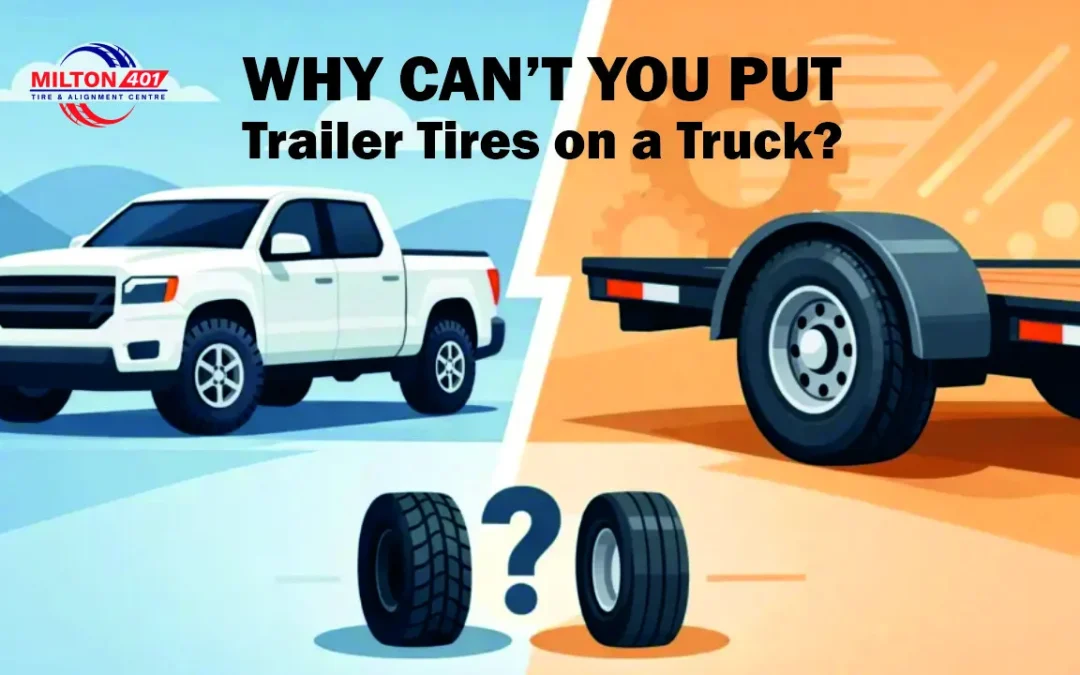
You usually hear this question after someone is trying to save money fast or get a truck back on the road with whatever tire is available: why can’t you put trailer tires on a truck? The short answer is that trailer tires and truck tires are built for different jobs. They may look similar at a glance, but the way they carry weight, handle cornering, manage heat, and respond under braking is not the same.
That difference matters more than most drivers realize. On a trailer, the tire is following. On a truck, the tire is steering, driving, braking, and carrying the vehicle through every road condition. If the tire is not designed for that role, you are giving up control, stability, and safety.
Why can’t you put trailer tires on a truck in the first place?
A trailer tire is engineered for free-rolling axle positions on equipment that does not steer or deliver engine power to the road. Its construction is focused on supporting vertical load and resisting trailer sway. That is very different from what a truck tire has to do every mile.
A truck tire has to manage acceleration, braking force, steering input, road shock, and weight transfer. It also needs a tread and sidewall design that can maintain grip while the vehicle changes direction, especially in wet conditions, on rough pavement, or under heavy load. Trailer tires are not built around those demands.
This is why putting trailer tires on a truck is not just a bad fit. It is the wrong application. Even if the size appears close, the tire’s internal construction and performance limits are not meant for a powered vehicle.
Trailer tires and truck tires do different jobs
The easiest way to understand the problem is to compare what each tire is expected to do.
What trailer tires are designed for
Trailer tires, often marked ST for Special Trailer, are built to carry heavy loads on non-powered axles. They are designed with stiffer sidewalls to reduce sway and keep the trailer more stable behind the tow vehicle. That stiffness helps the trailer track properly, but it does not mean better handling on a truck.
Their tread design is also optimized for trailer service, not steering precision or traction during acceleration. A trailer tire does not need to respond to the driver’s input the way a front truck tire does, and it does not need to transfer engine torque to the pavement like a rear drive tire.
What truck tires are designed for
Truck tires are built for vehicles that steer, brake, and in many cases drive through the tire itself. Whether you are talking about a light-duty pickup, a work truck, or a commercial truck, the tire must keep the vehicle controlled under changing loads and speeds.
That means stronger performance in cornering, better traction, and predictable behavior during emergency maneuvers. The casing, tread compound, and contact patch are all designed around active vehicle control, not passive load support.
The biggest risk is loss of handling and control
If you mount trailer tires on a truck, the first thing you may notice is that the vehicle does not feel right. Steering can feel vague. Braking may feel less stable. The truck can become less predictable during lane changes, hard stops, or wet-road driving.
That happens because trailer tires are not tuned for the side forces a truck creates in turns. They are not meant to grip and recover the same way a truck tire does. A tire that works acceptably under a trailer can feel unstable when it is asked to steer a loaded pickup or control a heavier commercial vehicle.
For a business operator, that is not a minor issue. Poor handling means more driver fatigue, more risk in emergency situations, and more wear on suspension components. For everyday drivers, it can mean the difference between maintaining control and losing it when traffic changes suddenly.
Load rating is not the whole story
One common mistake is assuming that if the trailer tire has enough load capacity, it should be fine on a truck. That is only part of the picture.
Load rating tells you how much weight the tire can support under specified conditions. It does not mean the tire is approved for steering axles, drive axles, or general truck service. A tire can have a high load rating and still be completely wrong for the application.
This is where people get caught. They see a tire that is heavy-duty, has a strong sidewall, and carries a lot of weight, and they assume it must be suitable for a truck. But tire selection is never just about weight. It is also about speed capability, heat resistance, traction, casing design, and intended service position.
Heat buildup is another serious problem
Tires live or die by heat. When a tire is used outside its intended application, excess heat can build up faster than expected. On a truck, especially one that sees highway driving, stop-and-go loads, or commercial use, the tire is under more complex stress than a trailer tire is designed for.
A trailer tire may not dissipate heat the same way when it is subjected to steering and drive forces. That can shorten tire life, increase the chance of irregular wear, and raise the risk of failure. On a busy route or during a workday, that kind of failure costs more than the price difference between the right tire and the wrong one.
For fleet operators, downtime is expensive. For personal drivers, a roadside tire issue is more than an inconvenience. It is a safety event.
Why can’t you put trailer tires on a truck if they fit the wheel?
Because physical fit does not equal safe fit. A tire can mount on a wheel and still be wrong for the vehicle.
You also have to consider the manufacturer’s intended use, the axle position, inflation requirements, and the performance standards that apply to the vehicle. Even when diameter and width seem close enough, the tire may still be unsuitable for braking, cornering, speed, or sustained road use on a truck.
This is the same reason experienced tire shops do not match tires by appearance alone. We match them by vehicle type, use case, load demands, and safety standards. That matters whether you run a single pickup or a full commercial fleet.
You may also run into legal, warranty, and liability issues
Using the wrong tire type can create problems beyond tire wear and handling. If the tire is not approved for the vehicle application, you may run into inspection issues, warranty denial, or liability exposure after an accident.
That matters even more for commercial vehicles. If a truck is operating with improper tires and there is a roadside incident, investigators and insurers will look closely at equipment condition. Saving money up front can become very expensive later.
There is also a practical side to this. If the truck wears out the tire unevenly or the tire fails early, you have not saved anything. You have paid for the wrong tire, then paid again to replace it properly.
Are there any exceptions?
For normal road use, the answer is simple: trailer tires belong on trailers, not on trucks.
The only time this starts to sound less straightforward is when someone is talking about temporary movement in a yard, a low-speed non-road situation, or a highly specific equipment setup. Even then, that is not the same as saying it is safe or acceptable for regular truck use. In real service conditions, the right answer is still to install the correct truck tire.
If you are unsure what belongs on your vehicle, check the tire placard, the owner’s manual, and the service requirements for your axle and load. Better yet, have a qualified tire technician confirm the correct fitment before you spend money.
The better question is what tire your truck actually needs
Instead of asking whether a trailer tire can work, it is smarter to ask what truck tire will do the job correctly. That depends on how the truck is used.
A daily-driven pickup may need a highway all-season tire with stable road manners and good wet traction. A work truck may need a heavier load range and tougher casing. A commercial unit may need application-specific tires based on steer, drive, or trailer position. The right answer depends on weight, mileage, road conditions, and how much downtime you can afford.
At Milton 401 Tire & Alignment Centre, that is the kind of call we help drivers and fleet operators make every day. The goal is not just to get a tire installed. It is to keep the vehicle road-ready, safe, and dependable under real working conditions.
If your truck needs tires, the safest money you can spend is on the right tire for the job. A trailer tire may look close enough in a hurry, but close enough is not what you want when your vehicle is carrying weight at highway speed.