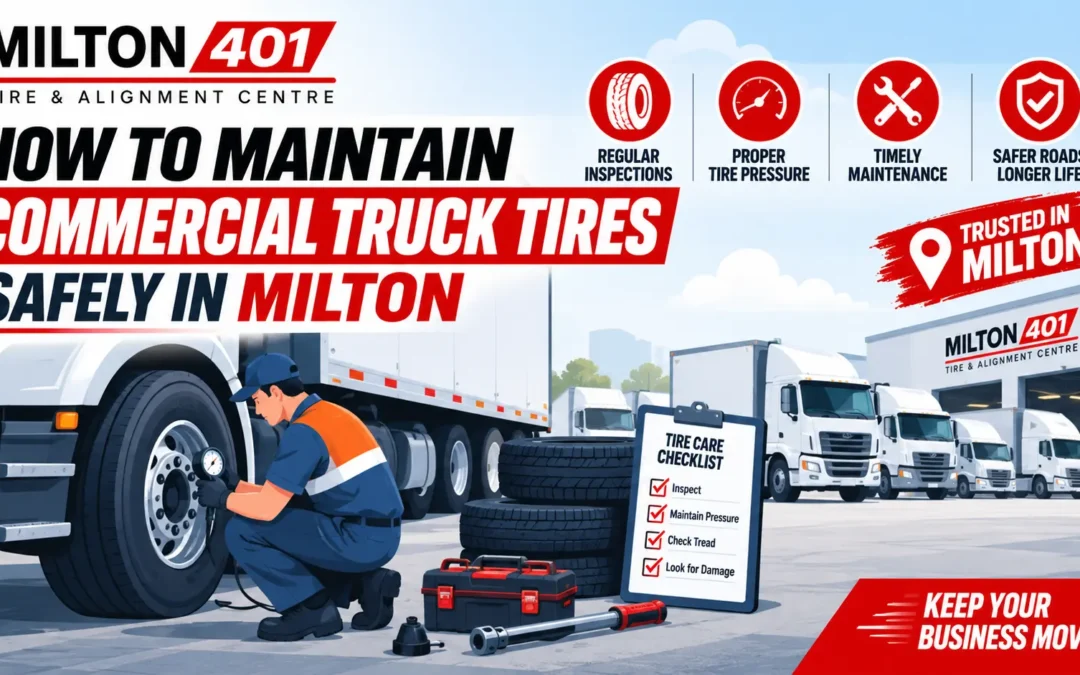
A tire failure on a loaded truck rarely begins as a roadside emergency. More often, it starts as a slow leak, an overloaded axle position, uneven wear or a missed inspection at the yard. For fleets running the 401, 407 and QEW corridor through Milton and the GTA, knowing how to maintain commercial truck tires is a practical way to prevent avoidable downtime, protect cargo and get more usable life from every casing.
Commercial tire maintenance isn’t just about checking tread before a long run. It’s a consistent process that connects inflation pressure, tire condition, wheel-end components, alignment, loading practices and repair decisions. When one part is ignored, the cost shows up quickly — in fuel use, irregular wear, lost retread value or an unplanned service call on a busy stretch of highway.
Quick answer: To maintain commercial truck tires safely, inspect them before every trip, check pressure when cold and matched to actual axle load, rotate every 6,000–8,000 miles, align every 80,000–100,000 miles and repair puncture damage before it forces a tire out of retread eligibility. Milton and GTA fleets can also lean on 24-hour mobile road service for roadside failures on the 401, 407 or QEW.
Daily and Pre-Trip Inspection Checklist
Build these checks into the normal operating routine, not just the pre-trip walk-around:
- Inspect before every trip — look at tires during the pre-trip inspection, again when stopping for fuel or a break and after any curb strike, road hazard or suspected impact.
- Check for visible damage — cuts, cracks, bulges, exposed cords, missing chunks of tread, embedded objects and sidewall scuffing.
- Pay extra attention to dual-tire assemblies — a damaged or underinflated tire in a dual position transfers extra load to its mate, creating heat and stress that can damage both tires.
- Watch for uneven wear — feathering, one-sided wear, cupping or rapid shoulder wear aren’t normal. They’re warning signs the truck may need alignment, suspension inspection, balancing or a review of loading and inflation practices.
- Report defects immediately — a tire that’s repairable in the yard can become a casing loss after another highway run.
Fleet managers should back this driver-level routine with scheduled shop inspections that catch issues a visual walk-around won’t reveal.
Check Tire Pressure When Cold
Correct inflation pressure is the foundation of commercial tire care. Pressure should match the tire manufacturer’s load-and-inflation guidance for the actual axle load, tire size and application — a blanket pressure target for every truck is convenient, but it can be wrong when equipment, payloads and axle weights vary.
Check pressure when tires are cold, ideally before the truck has been driven. Heat from normal operation raises pressure readings, making a hot tire harder to assess accurately. Use a dependable commercial-grade gauge or a calibrated tire pressure monitoring system and keep valve caps installed to protect valve cores from dirt and moisture — especially important through Ontario winters, when cold temperatures can cause ice to form on the valve core and create slow leaks.
Underinflation is costly: it increases sidewall flexing and heat buildup, accelerates shoulder wear, reduces fuel efficiency and raises the likelihood of failure. According to the U.S. Department of Energy, under-inflated commercial tires can reduce fuel economy by as much as 0.3% for every 1 PSI of under-inflation. Overinflation, on the other hand, reduces the contact patch and contributes to center wear, reduced traction and a harsher ride.
For fleet operations, record pressure readings and recurring adjustments. A tire that repeatedly loses pressure may have a puncture, a valve issue, a wheel problem or a bead-area leak that needs professional diagnosis.
Watch Tread Depth and Wear Patterns
Tread depth affects traction, braking performance and water evacuation. Tires may meet a minimum legal depth yet still be a poor choice for demanding routes, heavy rain, construction access roads or winter conditions. Replace tires based on position, service requirements, casing condition and fleet safety standards — not only when they hit the absolute minimum.
Measure tread in the major grooves at multiple points across the tire; one measurement doesn’t tell the whole story. Compare inner, center and outer readings to catch irregular wear early:
- Both shoulders wearing faster than the center → often indicates underinflation
- Excess center wear → can indicate overinflation
- Feathered tread → commonly suggests a toe alignment issue
- Wear concentrated on one shoulder → can point to camber concerns, worn suspension parts or an axle alignment problem
- Cupping → may involve balance, shocks, wheel-end components or suspension wear
Don’t assume every wear pattern has one cause. A qualified technician should inspect the tire and related components before recommending alignment or replacement — replacing a tire without correcting the source of the wear only restarts the same problem.
Rotate Tires on a Regular Schedule
Tire rotation balances wear across the fleet and extends usable tread life. Because commercial trucks pivot on the front drive axle when turning, rear tires typically wear faster than fronts, which is why a simple front-to-rear swap isn’t always the right pattern — steer, drive and trailer tires face different forces and often need different rotation schemes.
As a general guideline, tire manufacturer Michelin recommends rotating commercial truck tires every 6,000 to 8,000 miles, though the right interval for your fleet depends on vehicle type, tire design, axle position and route conditions. Follow your tire manufacturer’s specific recommendations and use your own wear records to fine-tune timing.
Align, Balance and Inspect the Whole Wheel End
Commercial truck tires are affected by more than the rubber on the road. Alignment, balancing, wheel condition, hubs, bearings, suspension components and brake-related heat all influence tire life.
As a benchmark, commercial vehicles typically need a wheel alignment every 80,000 to 100,000 miles — roughly the same interval at which steer tires are often replaced. A precision alignment is especially worth scheduling sooner after a hard pothole impact, curb strike, suspension repair, steering repair or when uneven steer-tire wear appears. It’s also worth checking when fuel economy slips without an obvious mechanical explanation — small angles create significant scrub over thousands of highway miles.
At Milton 401 Tire & Alignment Centre, we use Hunter alignment technology to catch angle deviations that a visual inspection would miss, which matters for fleets running heavy, consistent mileage on the 401 corridor.
Balancing matters too, particularly on steer positions. An out-of-balance assembly can contribute to vibration, driver fatigue, irregular wear and added stress on steering and suspension components. If a driver reports a new vibration, investigate it early — waiting for the next scheduled service can turn a manageable issue into a more expensive repair.
During scheduled maintenance, inspect wheels for cracks, corrosion, bent rims, damaged bead seats, loose or missing hardware and signs of air loss around the bead. Wheel-end inspections should also check for seal leaks, bearing issues and abnormal heat — a tire problem and a wheel-end problem can look identical from the outside, so a complete inspection saves diagnostic time later.
Manage Loads and Tire Positions Correctly
No maintenance routine can overcome chronic overloading. Commercial tires must be matched to the vehicle’s axle ratings and the load each tire is actually carrying — uneven cargo distribution can overload one axle or one side of a trailer even when total vehicle weight looks acceptable on paper.
Use accurate axle weights when possible, especially for fleets running variable loads. Check dual assemblies for matched tire size and similar remaining tread depth — large differences in rolling circumference force one tire to work harder than the other, creating heat and uneven wear.
If your fleet uses retreadable casings, protect that investment from the first mile. Maintaining correct pressure, repairing punctures promptly, preventing overloads and pulling damaged tires before they run flat all improve the odds a casing stays suitable for retreading.
Repair Damage Early — and Know When to Call for Road Service
Not every puncture requires replacement, but commercial tire repairs need careful evaluation. The location, size, angle and type of injury all matter. Tread-area punctures may be repairable when inspected and repaired properly from the inside; sidewall damage, run-flat damage, exposed cords and certain shoulder injuries usually mean the tire has to come out of service.
A temporary roadside repair can restore mobility in an urgent situation, but it shouldn’t replace a proper inspection. After a roadside event, have the tire checked for internal damage and confirm the wheel, valve and surrounding dual tire weren’t affected too.
If a tire fails while your truck or trailer is on the 401, 407, QEW or elsewhere in the GTA, Milton 401 Tire & Alignment Centre offers 24-hour mobile road service starting from $90, so a blowout doesn’t turn into a full day of lost route time. For yard-based fleets, our mobile yard service brings the same qualified diagnosis on-site — whether it’s a puncture, bead leak, alignment concern or damaged wheel.
Build Records That Prevent Repeat Problems
A fleet tire program gets more effective when maintenance findings are documented. Track tire position, brand and size, installation date, tread depth, pressure, repairs, rotations, alignment results and removal reason. A consistent digital inspection log — even a simple one — can reveal patterns that are easy to miss truck by truck.
For example: repeated inner-shoulder wear on a specific trailer may point to an alignment issue. Frequent punctures on a route may justify reviewing route conditions or tire selection. High pressure-loss rates across a group of wheels may indicate aging valves, corrosion or equipment damage.
Review these records regularly with your service provider. The goal isn’t paperwork for its own sake — it’s replacing reactive tire spending with planned maintenance that keeps trucks road-ready.
Commercial Truck Tire Maintenance FAQs (Milton & GTA)
How often should commercial truck tires be rotated?
Michelin recommends rotating commercial truck tires every 6,000 to 8,000 miles, though the ideal interval depends on axle position, tire design and route conditions. Fleet-specific wear records are the most reliable way to fine-tune the schedule.
How often do commercial trucks need a wheel alignment?
Most commercial vehicles need an alignment every 80,000 to 100,000 miles or sooner after a pothole impact, curb strike, suspension repair or when uneven steer-tire wear appears.
What’s the biggest cause of premature commercial tire wear?
Underinflation is one of the most common causes. It increases heat buildup and sidewall flexing, accelerates shoulder wear and reduces fuel efficiency — which is why checking pressure cold and matching it to the actual axle load, matters more than following a single blanket target.
Does Milton 401 Tire & Alignment Centre offer emergency road service for trucks?
Yes. Milton 401 Tire & Alignment Centre provides 24-hour mobile road service starting from $90 for trucks and trailers along the 401, 407, QEW and surrounding GTA area, along with yard service, alignment (using Hunter alignment technology) and fleet accounts.
Can a punctured commercial truck tire be repaired?
It depends on the location and type of damage. Tread-area punctures are often repairable when properly inspected and repaired from the inside; sidewall damage, run-flat damage and exposed cords typically require the tire to be taken out of service.