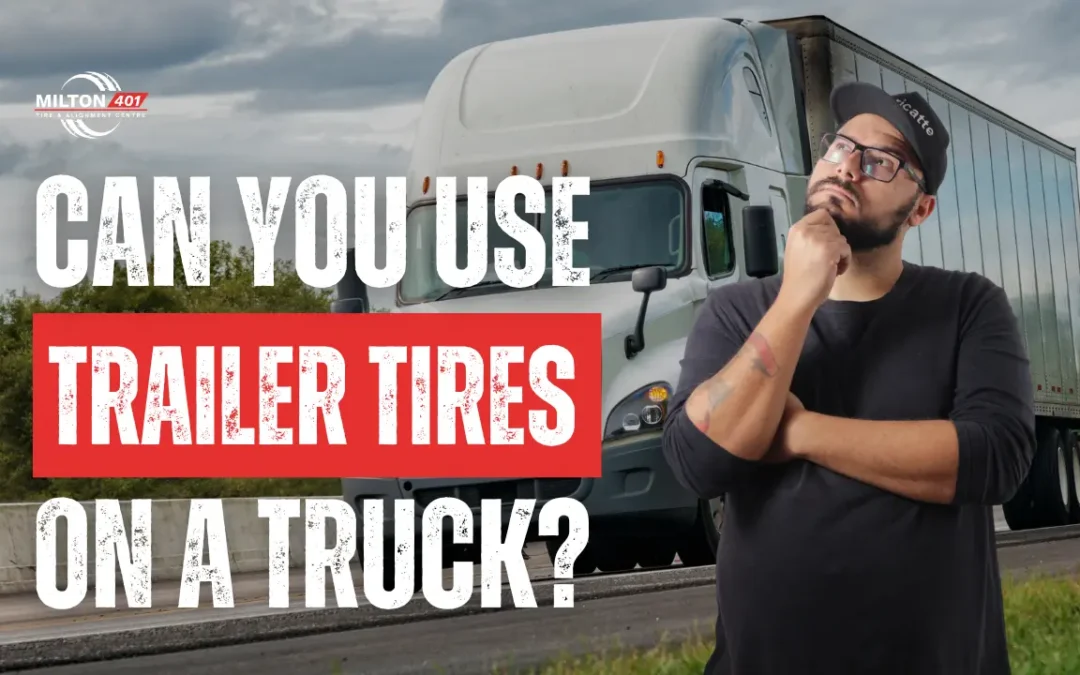
A customer usually asks this after spotting a matching size on the sidewall and thinking the swap might save time or money. It is a fair question, but can you use trailer tires on a truck? In most cases, no – and using the wrong tire can create serious problems with handling, braking, heat buildup, and overall safety.
A trailer tire and a truck tire may look similar at a glance, but they are built for different jobs. That difference matters on the road, especially if you drive daily, haul equipment, tow for work, or manage a commercial vehicle that cannot afford downtime.
Why trailer tires and truck tires are not the same
Trailer tires are engineered for free-rolling axles. They are designed to carry heavy vertical loads while following behind a tow vehicle. That means the tire’s construction focuses on load stability, reduced sway, and durability under trailer-specific stress.
Truck tires have a different job. They must handle steering, acceleration, braking, cornering, and in many cases changing road conditions. On a pickup, van, or work truck, the tires are part of how the vehicle responds to driver input. They need sidewall flexibility, traction, and tread characteristics that support control, not just load carrying.
This is where many problems begin. A trailer tire may physically fit a truck wheel in some situations, but physical fit is not the same as proper application. If the tire was not designed for a powered or steering axle, it should not be treated like a truck tire.
Can you use trailer tires on a truck in any situation?
For normal road use, the answer is generally no. Trailer tires, often marked ST for Special Trailer, are not intended for steer axles or drive axles on trucks. They do not provide the same traction, handling response, or heat management you need on a vehicle that actively drives and stops under its own power.
There is a difference between what mounts and what performs safely. Some operators see the same diameter, similar load range, and compatible wheel pattern and assume it is acceptable. The risk is that the tire’s internal construction and intended use do not match the demands of the truck.
In a true emergency, people sometimes install whatever gets the vehicle moved off the shoulder or into a yard. That is a temporary roadside decision, not a proper service solution. If that happens, the tire should be replaced with the correct truck-rated tire as soon as possible.
The biggest safety issues with using trailer tires on a truck
The first issue is traction. Trailer tires are not built to deliver the same grip under acceleration or braking. On a truck, especially in rain, heat, or loaded conditions, that can mean longer stopping distances and less stable control.
The second issue is sidewall behavior. Trailer tires are often built with stiffer sidewalls to control trailer sway and support load. That sounds like a benefit, but on a truck, the wrong sidewall design can affect ride quality, steering feel, and cornering stability in ways the suspension was not designed for.
Heat is another concern. Tires generate heat based on speed, load, inflation, and application. A tire designed for trailer use may not manage heat the same way when installed on a powered axle. Excess heat leads to faster wear and increases the chance of failure.
Then there is tread design. Truck tires are built with specific tread patterns for traction, water evacuation, and even wear under steering and drive forces. Trailer tires are tuned for a different wear pattern because they are not responsible for powering the vehicle or turning it.
Load rating does not tell the whole story
A common mistake is focusing only on load capacity. If a trailer tire can carry a similar or even higher load than the truck tire, some drivers assume it should be acceptable. That is only one part of the equation.
A proper tire choice also depends on speed rating, application type, construction, axle position, and vehicle manufacturer requirements. A tire can have enough carrying capacity and still be the wrong tire for the job.
This is especially relevant for work trucks and commercial vehicles. If you are hauling tools, equipment, or materials, your tires need to support the weight while also delivering predictable handling. A tire built only for trailer duty does not give you that complete performance package.
What happens if you put trailer tires on a pickup or work truck?
Sometimes the result is obvious right away. The truck may feel vague in corners, unstable under braking, or rougher than normal over bumps. In other cases, the problem shows up over time as irregular wear, overheating, or reduced tire life.
On a loaded truck, those problems can get worse quickly. A vehicle that already works hard needs the correct tire construction to stay controlled and dependable. If the tire is not designed for steering input or drive torque, you are creating a weak point in the setup.
For fleet operators, this becomes more than a maintenance issue. Tire mismatch can lead to unplanned service calls, roadside breakdowns, and lost operating time. That costs more than fitting the correct tire in the first place.
The legal and liability side matters too
Using the wrong tire type can create inspection issues and raise liability concerns after an accident. If a tire fails or contributes to poor vehicle control, investigators and insurers may look at whether the tire was appropriate for the vehicle.
That matters for private drivers, but it matters even more for businesses. If you run commercial trucks, service vans, or towing vehicles, tire choice is part of basic roadworthiness. The right tire protects not only the vehicle and cargo, but also the operator and everyone else on the road.
When drivers get confused about tire markings
Part of the confusion comes from sidewall codes. P-metric tires are for many passenger vehicles and light-duty use. LT stands for Light Truck and is designed for pickups, vans, and heavier service. ST stands for Special Trailer and is built specifically for trailer applications.
Those letters are not interchangeable. An ST tire is not just another version of an LT tire. It is a purpose-built trailer tire with a different engineering target.
If you are comparing sizes and only looking at the numbers, you can miss the most important part of the tire designation. The application code at the beginning tells you what the tire was made to do.
What should you use instead?
If the vehicle is a truck, use a tire rated for truck service and matched to the way the vehicle is used. That may mean an LT tire for a pickup or commercial van, or a heavier-duty commercial truck tire depending on the axle and load requirements.
The right choice depends on several things: how much weight the truck carries, whether it tows regularly, how often it runs highway miles, and whether it sees job sites, city driving, or long-haul routes. A truck used lightly on weekends does not need the exact same tire setup as a fleet vehicle working every day.
That is why tire selection should go beyond size alone. Load index, ply rating, inflation requirements, tread design, and axle position all matter. Getting one of those wrong can shorten tire life or affect performance.
A practical rule for truck and trailer owners
Use trailer tires on trailers and truck tires on trucks. It sounds simple because it is. The safest, most dependable setup is always the one that matches the tire to the vehicle’s actual function.
If you own both a truck and a trailer, each should have its own proper tire type. The trailer needs tires that support load and stability behind the tow vehicle. The truck needs tires that can steer, brake, accelerate, and carry weight safely.
At Milton 401 Tire & Alignment Center, this is the kind of issue we see when drivers are trying to keep equipment moving fast. We understand the pressure to get back on the road, but the better call is to fit the correct tire now instead of dealing with uneven wear, poor handling, or a roadside failure later.
If you are unsure whether a tire is right for your truck, do not guess based on size alone. A quick check by a qualified tire professional can save you from a much bigger problem down the road.